If your organic traffic shifted in recent months, you are not the only one. Google launched two core algorithm updates in just sixteen weeks during 2026, something that previously took four to six months.
For businesses in Venezuela and the rest of Latin America, this means one concrete thing. Web positioning is no longer sustained by tricks or generic content written solely to rank.
In this guide, I explain what core updates are, why they accelerated in 2026, how to diagnose a real drop, and what concrete actions are working both to rank on Google and to appear cited in artificial intelligence answers.
What is a core update and why does it matter in 2026?
A core update is a broad update to Google central systems that recalibrates how the quality of all indexed web pages is evaluated. It does not target a specific site.
It is more useful to think of it as a panel adjusting its evaluation criteria. Nobody cheated, but the order of results changes because the bar for what is considered helpful content was raised.
Google confirms this in its official documentation on core updates. There is no list of violations to fix, but rather content that can be improved compared to what is already ranking.
This also means that a core update is not a penalty. Penalties are manual actions, notified inside Search Console, and respond to specific violations of Google policies.
The core update landscape in 2026
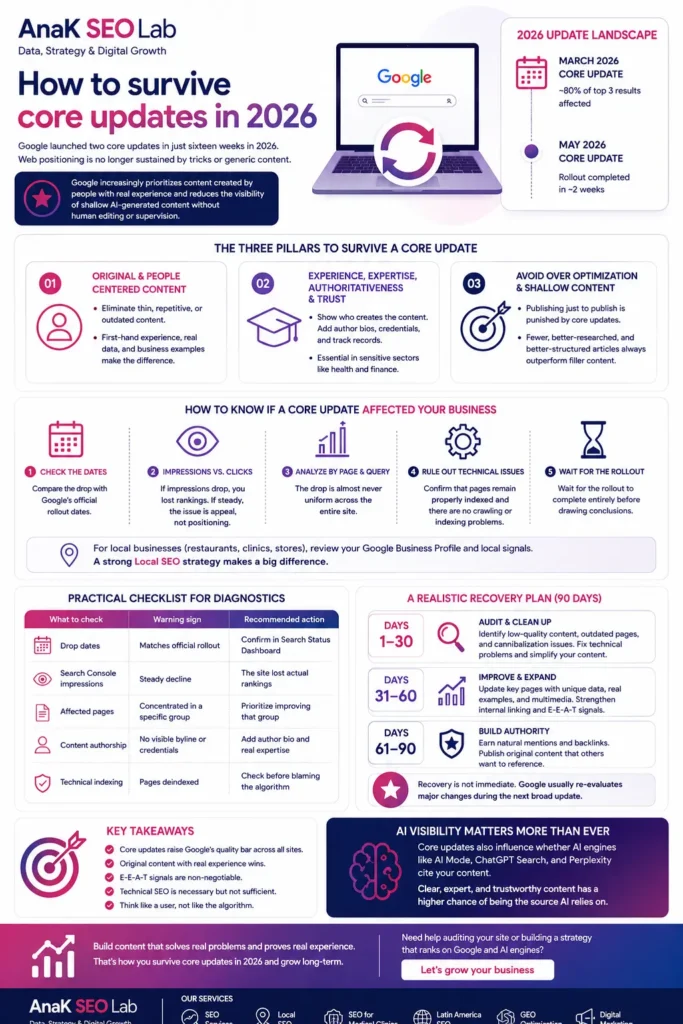
The year 2026 has been an unusually active year for the search algorithm. The March core update affected close to eighty percent of top three results, the highest figure recorded up to that moment.
Two months later came the May core update, right after the Google IO announcement regarding deep changes in how search works. The rollout took around two weeks to complete.
The pattern left by both updates is consistent. Google increasingly prioritizes content created by people with real experience and reduces the visibility of shallow pages generated with AI lacking human editing or supervision.
For a business in Barquisimeto, in Caracas, or in any city across Latin America, understanding this pace is key. Digital competition in the region is still lower than in markets like the United States or Spain, so acting properly now builds a faster advantage than usual.
The three pillars to survive a core update
After analyzing the behavior from May and March 2026, three factors explain why some sites gain visibility while others lose it.
1. Original and people centered content
Eliminate or improve pages with thin, repetitive, or outdated information that does not provide real value to the user. Google calls this helpful content for people, not for the algorithm.
A page that answers the exact same thing as twenty others in the top ten has no reason to rank higher than them. The difference is marked by first hand experience, verifiable data, and real business examples.
2. Signals of experience, expertise, authoritativeness, and trust
Show clearly who creates the content. Add author bios, verifiable credentials, and proven track records, especially in sensitive sectors like health or finance where Google is particularly strict.
If you work with a clinic or health business, this point is not optional. You can review how this strategy is applied in our SEO for medical clinics service.
3. Avoiding over optimization and shallow content
Publishing just to publish is exactly the type of practice that a core update punishes most heavily. Fewer articles that are better researched and better structured consistently outperform a blog full of filler.
This also applies to internal linking. A well planned SEO services strategy prioritizes topical depth over the volume of published pages.
How to know if a core update affected your business in Latin America
Before touching your site, confirm the diagnosis. Many drops attributed to Google are actually seasonality, a technical issue, or a recent change on the site.
- Compare the exact date of the drop with the official rollout dates published by Google.
- Check if impressions drop or only clicks. If impressions remain steady, the problem lies in the appeal of the result, not in positioning.
- Analyze page by page and query by query. The drop is almost never uniform across the entire site.
- Rule out technical issues first. Confirm that pages remain properly indexed.
- Wait for the rollout to complete entirely before drawing final conclusions.
For businesses relying on local searches, such as restaurants, clinics, or physical stores, this diagnosis is even more important. A local SEO service or SEO local en Venezuela strategy requires reviewing the Google Business Profile listing as well, not just the blog.
Practical checklist for diagnostics
| What to check | Warning sign | Recommended action |
| Drop dates | Matches official rollout | Confirm in Search Status Dashboard |
| Search Console impressions | Steady decline | The site lost actual rankings |
| Affected pages | Concentrated in a specific group | Prioritize improving that group |
| Content authorship | No visible byline or credentials | Add author bio and real expertise |
| Technical indexing | Pages deindexed | Check before blaming the algorithm |
A realistic recovery plan
Recovery after a core update is not immediate. Google usually reevaluates major changes during the next broad update, so establishing a ninety day plan prevents hasty decisions.
The first few weeks are dedicated solely to diagnosing without touching anything else. Afterwards, the content of affected pages is improved by adding real experience, proprietary data, and concrete answers to what people are searching for.
The following weeks focus on consolidation. Merge competing articles, eliminate pages that add no value, and strengthen internal linking toward the content that truly matters.
Close the cycle by reinforcing trust signals across the entire business. This includes your business profile, reviews, external mentions, and everything that proves the business behind the website is real.
If you prefer a specialized team to audit your situation, our business SEO services include this exact type of comprehensive diagnosis.
How to optimize for generative AI and AI mode in 2026
This is where most guides fall short. Surviving a core update in 2026 no longer depends solely on traditional SERPs, but also on appearing cited in AI Overviews, Google AI Mode, and assistants like ChatGPT, Perplexity, or Claude.
Optimization for answer engines, known as AEO or GEO, shares the same foundation as classic SEO, but requires specific adjustments.
- Answer the main question directly in the first few lines of content, without beating around the bush.
- Use clear headings, lists, and tables that make it easy for a language model to extract information.
- Include proprietary data, figures, and verifiable examples that a model cannot find on every other page.
- Mark authorship with names, experience, and links to real profiles, as models prioritize sources with verifiable identities.
- Maintain topical consistency across the entire site to consolidate authority on the subject, not just on a single keyword.
This combined approach is exactly what we implement in our GEO optimization service, designed for businesses that want to appear both in Google and in AI generated answers.
Mistakes you must avoid after a drop
- Redesigning the entire website all at once. Changing design, URLs, and structure simultaneously destroys historical data and makes it impossible to identify what caused the drop.
- Deleting content in bulk without prior analysis.
- Buying links urgently as an emotional reaction.
- Publishing dozens of mass produced articles to try to regain traffic volume.
- Changing strategies every week instead of holding a data backed plan.
An e-commerce business is especially vulnerable to these mistakes because it relies heavily on organic traffic for direct sales. If this is your case, review how we structure our work in e-commerce SEO.
The 2026 core updates FAQs
Is a core update a Google penalty?
It is not. A penalty is a manual action notified through Search Console. A core update recalibrates how all web content is evaluated without targeting individual sites.
How long does it take for a site to recover?
Most significant recoveries consolidate between eight and twelve weeks after applying real improvements, although full reflection usually arrives with the next broad update.
Should I wait before making changes to my website?
Yes. It is recommended to wait until the rollout is fully complete and to confirm data in Search Console before making definitive decisions.
Is AI generated content prohibited?
It is not prohibited, but content published without editing or human supervision consistently loses visibility. Human review and real experience remain the key differentiators.
How does this affect small businesses in Latin America?
Lower digital competition in several markets across the region presents an opportunity. A business that correctly applies these principles can gain ground faster than in more saturated markets like the United States, especially when leveraging specialized Latin America SEO services.
Summary and key takeaways
The 2026 core updates do not punish websites at random. They reward businesses that build useful content, demonstrate real experience, and adapt to both Google and AI powered search.
The winning strategy does not change with every update. It relies on quality, trust, and consistency, tailored to your market and growth stage.
If your traffic dropped, or if you want to build a solid foundation before the next update, at AnaK SEO Lab we design comprehensive digital marketing services and specialized SEO services tailored for businesses in Venezuela, the United States, and across Latin America.
Review our case studies or contact us for an evaluation of your current situation and a clear action plan.
Leave a Reply