
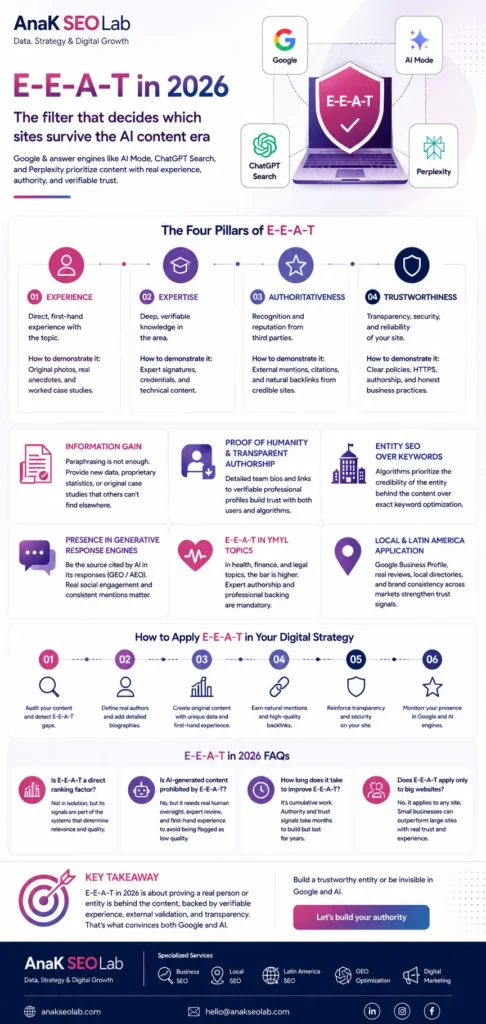
In 2026, E-E-A-T stopped being a style recommendation and became the filter that decides which sites survive the saturation of AI generated content. Flawless technical SEO is no longer enough if there is no real and verifiable entity behind it.
Google and answer engines like AI mode, ChatGPT Search, and Perplexity are pushing aside pages that sound correct but fail to demonstrate who wrote them or why we should trust their answer.
In this guide I explain what E-E-A-T means this year, what actually changed compared to previous versions of the framework, and how to apply it to a business in Venezuela or Latin America competing in both Google and artificial intelligence environments through specialized Latin America SEO services.
What is E-E-A-T and why did it become the definitive filter?
E-E-A-T stands for experience, expertise, authoritativeness, and trustworthiness. Google uses it to evaluate the quality of any content, although it is not a direct ranking factor like page loading speed.
What changed in 2026 is the surrounding context. The saturation of mass produced AI content forced algorithms to become much more demanding with the signals that distinguish a real entity from generic text without backing.
This does not mean that technical SEO stopped mattering. It means that it is no longer sufficient on its own, which is why we combine it with strategy in our SEO services.
The four pillars of E-E-A-T explained
Each pillar fulfills a distinct function, but all of them reinforce one another. None compensates for the absence of the other three.
| Pillar | What it evaluates | How to demonstrate it |
| Experience | Direct first hand experience with the topic | Original photos, real anecdotes, worked case studies |
| Expertise | Deep verifiable knowledge | Expert signatures, credentials, technical content |
| Authoritativeness | Recognition from third parties | External mentions, citations, natural backlinks |
| Trustworthiness | Site transparency and security | Clear policies, HTTPS, explicit authorship |
1. Experience
Google rewards direct first hand experiences over purely theoretical content. An original photo or a first person anecdote holds more weight than a well written summary without real backing.
2. Expertise
Deep knowledge is required, especially in critical topics such as health, finance, or law. A text without a recognized expert signature loses strength compared to one that has it.
3. Authoritativeness
Reputation is consolidated with external mentions, quotes from other professionals, and natural backlinks from credible sites. It is not bought, it is built over time.
4. Trustworthiness
It remains the overarching pillar. A website without a clear privacy policy, without HTTPS, or with deceptive commercial tactics loses trust regardless of how good the content is.
Information gain and why paraphrasing is no longer enough
Search engines penalize pages that only reformulate what already exists in ten other results. To rank in 2026, it is practically mandatory to provide new data, proprietary statistics, or original case studies.
This is known as information gain. If your content does not give anyone a real reason to cite you instead of citing someone else, the algorithm has no reason to prefer you.
A practical way to achieve this is to document your own business results, as we make visible in our case studies.
Proof of humanity and transparent authorship
Online reputation management is now a direct part of SEO strategy, not a separate brand layer. Content must include detailed team biographies and links to active, verifiable professional profiles.
This is especially relevant if your business belongs to a sensitive sector. In SEO for medical clinics, for example, verifiable authorship is not optional, it is a trust requirement for both the user and the algorithm.
Entity SEO over keywords
Current algorithms prioritize the credibility of the entity, meaning the brand or person behind the content, over exact keyword optimization. External reviews, press mentions, and the global digital footprint determine much of the final ranking.
This changes how content strategy must be designed. It is not just about which words to use, but how recognizable your brand is across the complete digital ecosystem, something we integrate into our business SEO services.
Presence in generative response engines
Optimization no longer aims solely at the traditional click. It seeks to be the source cited by artificial intelligence in its interactive summaries, known as GEO or AEO.
Having a solid profile with real social interaction and consistent mentions directly influences whether AI tools use your site as a trusted source instead of ignoring it.
This combined approach of E-E-A-T and AI visibility is exactly what we work on in our GEO optimization services, designed for businesses that want to be cited in Google and generative response engines alike.
E-E-A-T in sensitive health, finance, and legal sectors
In topics known as YMYL, where bad information can affect health, money, or personal safety, Google applies the framework with much more rigor than in any other content type.
An article about medical treatments or financial investments without clear authorship and professional backing has little chance of ranking, regardless of how well written it is. The signature of the expert behind the content is as important as the content itself.
How to apply E-E-A-T in Venezuela and Latin America businesses
For local businesses, trust is also built outside the website. A complete Google Business Profile, real reviews, and consistent presence in local directories reinforce the same signals that Google evaluates in content.
This is particularly relevant in markets where digital competition is still lower, as we address in our local SEO solutions, where a well built entity can stand out quickly.
For companies operating across multiple countries in the region, brand consistency across markets also counts. This is handled specifically through our Latin America SEO services.
E-E-A-T in 2026 FAQs
Is E-E-A-T a direct ranking factor?
It is not in isolation, but its signals integrate into the systems that determine relevance and quality. A site with solid E-E-A-T usually obtains better impressions and long term positions.
Is AI generated content prohibited by E-E-A-T?
It is not prohibited, but it requires real human backing. Adding verifiable authorship, expert review, and first hand experience is what prevents it from being flagged as low quality content.
How long does it take to improve the E-E-A-T of a website?
It is cumulative work, not a one time adjustment. Authority and trust signals are built over months, but they sustain themselves for years once consolidated.
Does E-E-A-T apply only to large websites or also to small businesses?
It applies to any site. A small business with real experience and transparent authorship can outperform a large site without a face behind the content in trust.
Summary and key takeaways
E-E-A-T in 2026 means proving that a real person or entity stands behind the content, supported by verifiable experience, external backing, and technical transparency. None of the four pillars works in isolation.
The same logic that convinces Google is what convinces AI models when deciding which source to cite. Building a trustworthy entity is no longer optional, it is the foundation of any sustainable strategy.
If you want to reinforce your brand authority and trust before Google and AI, at AnaK SEO Lab we design specialized SEO services and comprehensive digital marketing services tailored for businesses in Venezuela, the United States, and Latin America.
Review our recent case studies or contact us for an audit of your digital entity and a clear action plan.
Leave a Reply