

You published your list of the best products, services, or tips, and for years it worked. Today you check Search Console and the graph is going down without you having touched anything.
It is no coincidence. Listicle articles are the format feeling the 2026 shift the most, because they combine three problems at once: they are easy to summarize with artificial intelligence, they age quickly, and they often lack first hand experience.
In this guide I explain why this is happening, how to confirm the diagnosis on your own site, and what adjustments are working for businesses in Venezuela and Latin America that want to keep generating real traffic, not just impressions.
The real problem behind lists that no longer convert
A list article answers questions like what the best options for something are. That format used to win clicks easily because it promised a quick, structured answer.
The problem is precisely that. A quick, structured answer is exactly what an artificial intelligence system can generate without the user visiting your page.
Google confirms this in its own traffic drop troubleshooting documentation. When another result answers with more authority, freshness, or usefulness, your position loses clicks even if you technically remain indexed.
Direct AI answers are stealing clicks from your lists
AI Overviews and Google AI mode generate comprehensive summaries directly on the search results page. When the query is informational, like the best of something or types of something, that summary is often enough for the user.
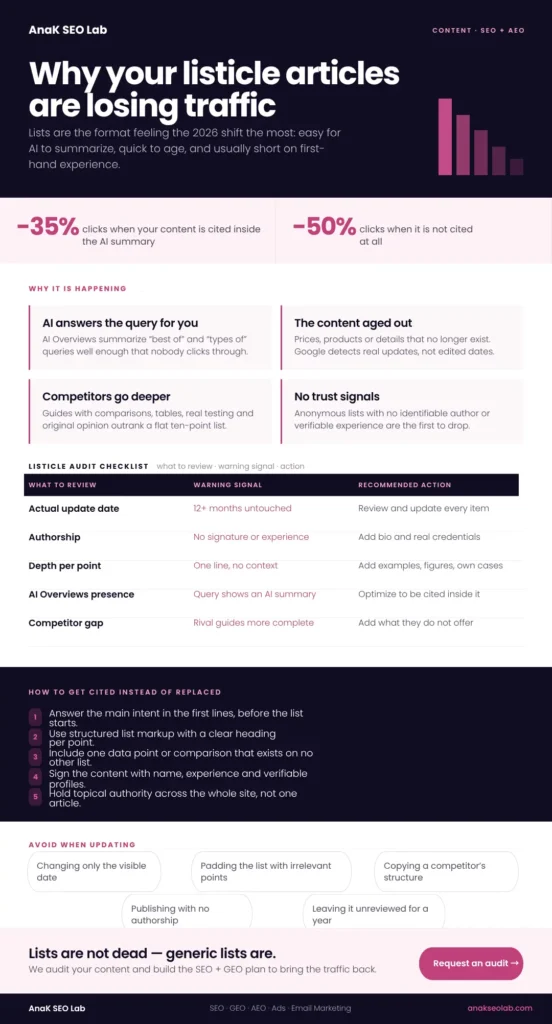
Recent studies on AI Overviews show click drops exceeding thirty five percent when your content is cited inside the summary, and over fifty percent when it is not cited at all.
Purely transactional queries, such as buying a specific product, are far less affected. That is where a transactional content strategy continues to work, something we address in our e-commerce SEO services.
The practical takeaway is simple. The more generic your list is, the easier it is for AI to summarize it without sending you traffic.
Outdated content, another silent reason for the drop
A list published three years ago likely mentions prices, products, or details that no longer exist. Google detects when content was actually updated, not just the date visible on the page.
If your article still mentions a discontinued product or a price from 2023, the user notices and so does the algorithm. Trust is lost before the reader finishes the first line.
Updating does not mean changing the date. It means reviewing every item on the list, verifying it remains valid, and adding context that did not exist when you wrote the original version.
When competitors make more complete lists than yours
Many large websites are investing in longer guides with comparisons, tables, and original opinions that completely surpass a simple ten point list without depth.
If your direct competitor publishes a guide with original screenshots, real testing, or interviews, and you publish a generic list, Google has objective reasons to prefer the other page.
This does not mean writing more for the sake of it. It means every item on your list must contribute something competitors lack, whether local data, a proprietary case, or a perspective only your business can provide.
Lack of trust signals in your list articles
Anonymous lists without an identifiable author and without verifiable experience are the first to lose rankings. Google increasingly prioritizes who signs the content and what authority they have on the topic.
This is especially sensitive in sectors like health or finance, where a list of recommendations without professional backing can be deemed untrustworthy. If your business belongs to this sector, review how we address it in SEO for medical clinics.
Adding an author bio, links to real profiles, and verifiable data is not an aesthetic detail. It is a direct trust signal that both Google and AI models use to decide what to cite.
How to diagnose if your lists are losing traffic
Before rewriting anything, confirm the diagnosis inside Search Console. Google recommends a specific protocol for this in its official troubleshooting documentation.
- Check whether the drop affects a single page, several pages, or the entire site, comparing the current period with a previous one of equal duration.
- Observe whether impressions are dropping or only the click through rate. If impressions remain stable, other search results look more attractive than yours.
- Confirm that your pages remain correctly indexed before assuming a content quality issue.
- Look for patterns by query, country, and device to isolate exactly which segment experienced the decline.
- Compare your content with results that maintain their positions. Ask yourself if they offer more depth, freshness, or structure.
Practical checklist for auditing a listicle article
| What to review | Warning signal | Recommended action |
| Actual update date | More than twelve months without changes | Review and update each item on the list |
| Content authorship | No signature or visible experience | Add bio and real credentials |
| Depth per point | Single line without context or data | Expand with examples, figures, or proprietary cases |
| Presence in AI Overviews | Query shows AI summary | Optimize to appear cited inside the summary |
| Comparison with competitors | Rival guides are more complete | Add what competitors do not offer |
How to optimize your lists for AI Overviews AI mode and LLMs
Answer engine optimization, known as AEO or GEO, does not replace traditional SEO, it complements it. For a list article, specific adjustments increase the chances of being cited instead of replaced.
- Answer the main intent in the first few lines, before starting the list.
- Use structured list markup data with clear headings for each point.
- Include at least one piece of data, figure, or comparison that does not exist on any other list on the same topic.
- Sign the content with name, experience, and links to verifiable profiles.
- Maintain topical authority across your entire website, not just in a single article.
This combined adjustment between classic SEO and AI visibility is exactly what we work on in our GEO optimization services, designed for businesses that want to appear in Google and AI generated answers.
How to turn generic lists into high converting content
Not all lists need to disappear. Those with transactional intent, such as comparing specific products before buying, continue to receive traffic because AI cannot make the final decision for the user.
The key lies in turning a generic informational list into a guide with conversion intent. Add unique selection criteria, real testimonials, and a clear call to action toward your service or product.
For local businesses in Venezuela or Latin America, this pairs well with a local SEO strategy, where a well crafted list can become the gateway for real customers, not just casual visits.
If you are looking for a complete review of your content strategy, our business SEO services include this exact type of diagnosis and action plan.
Mistakes to avoid when updating a list article
- Changing only the visible date without updating the actual content.
- Making the list longer with irrelevant points just to increase the word count.
- Copying the exact structure of a competitor without providing your own perspective.
- Ignoring authorship and publishing without any signals of real experience.
- Leaving the list without review for more than a year.
Lists losing traffic FAQs
Do lists still work at all?
Yes, they work, but enumerating generic points is no longer enough. Lists with transactional intent, proprietary data, and clear authorship continue to generate quality traffic.
How often should I update a list article?
As a general guideline, review every six months the articles with higher historical traffic and immediately update any data, price, or product that has changed.
Does being cited in an AI Overview replace a normal click?
It does not replace it, but it improves the click through rate compared to not being cited at all. Both goals coexist in a combined SEO and GEO strategy.
Should I delete my old lists?
Not immediately. First identify which ones receive impressions and relevant queries, and prioritize updating them before deciding to delete or merge them with other content.
Summary and key takeaways
A list article loses traffic when it stops providing something that artificial intelligence cannot summarize on its own. The solution is not to abandon the format, but to make it more specific, current, and verifiable.
The combination of updated content, real authorship, and optimization for Google and AI models sustains traffic over the long term, rather than relying on a short term trick.
If your lists stopped bringing visits or clients, at AnaK SEO Lab we audit your content and design specialized SEO services and comprehensive digital marketing services tailored to your business in Venezuela, the United States, or Latin America.
Review our case studies or contact us for a review of your content and a clear action plan.
Deja un comentario